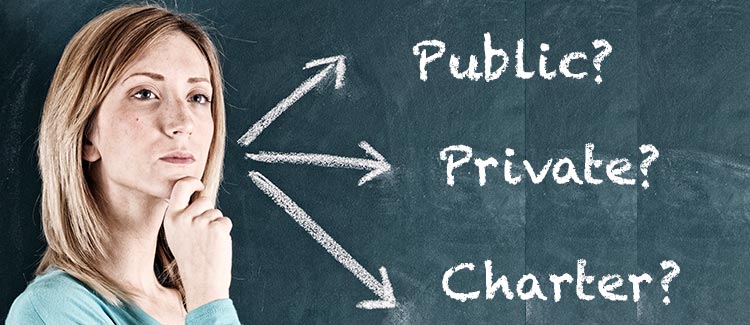
The most important distinction is simple: a charter school is not a private school. In Colorado, charter schools are tuition-free public schools of choice open to all students. Private schools are non-public institutions that generally charge tuition and manage their own admissions and programs.
Charter school vs private school at a glance
| Factor | Charter school | Private school |
|---|---|---|
| School type | Public school of choice | Independent/non-public school |
| Tuition | Tuition-free | Usually charges tuition; aid varies |
| Admission | Open enrollment; lottery or priorities when applications exceed seats | School sets its own application and admission standards, subject to applicable law |
| Accountability | Authorized by a district or the Colorado Charter School Institute; public-school accreditation and state testing apply | CDE does not approve, register, endorse, or accredit Colorado private schools; some seek independent accreditation |
| Curriculum | May use a distinctive model but remains a public school accountable under its charter | Often has more control over mission, program, religion, schedule, and teaching approach |
| Transportation | Not guaranteed; verify with the school or authorizer | Usually family-provided unless the school offers a route |
| Special education | As a public school, must serve eligible students under IDEA and applicable public-school requirements | Parentally placed students do not have an individual entitlement to the same IDEA services they would receive in public school |
What is a charter school?
In Colorado, a charter school is operated by a group such as parents, educators, or community members under a contract with a local district or the Colorado Charter School Institute. It may have more flexibility in program and operations, but it remains a tuition-free public school, is open to all students, and participates in state-required assessments such as CMAS and PSAT/SAT.
Families generally apply rather than receive an automatic neighborhood assignment. When applications exceed available seats, the school must use a nondiscriminatory selection process, typically a lottery operating within published enrollment priorities.
What is a private school?
Private schools include independent, religious, and other non-public schools. The Colorado Department of Education states that it does not approve, register, endorse, or accredit private schools, although some voluntarily pursue accreditation from independent organizations. Do not treat the word private as a quality credential: verify accreditation, curriculum, teacher requirements, tuition, refund terms, discipline policies, and outcomes directly.
Cost: tuition-free does not mean cost-free
A charter school cannot charge K–12 tuition, but families may still pay for meals, before- or after-care, activities, uniforms, supplies, and transportation. Private schools commonly charge tuition and may add application, enrollment, technology, activity, or other fees. Financial aid varies by school. Compare the full annual cost rather than the headline tuition alone.
Special education deserves early, specific questions
Charter schools are public schools and must meet applicable IDEA obligations. A child placed in private school by a parent does not have an individual entitlement to the same IDEA services the child would receive in public school. The responsible district may provide some equitable services, but that is different from an individual right to the full public-school program. Before enrolling, ask both the school and the responsible district about evaluation, an IEP or services plan, therapies, staffing, and service location.
How does a Denver address affect the decision?
Denver Public Schools uses SchoolChoice for applications to district options, including charter schools. For 2026–27, families may rank up to 12 schools in the main application process; later Round 2 applications follow current availability and priority rules. Private-school admission generally sits outside DPS SchoolChoice, and living nearby does not guarantee acceptance.
A practical 10-question checklist
- Does the instructional model fit the student’s learning needs?
- What are the deadlines, priorities, and lottery or admission rules?
- What is the full annual cost?
- How will daily transportation work?
- Is there independent accreditation, and when was the latest review?
- What do student growth, outcomes, and graduation pathways show?
- How are IEPs, Section 504 needs, English learners, or other supports handled?
- What are class size, staff turnover, and teacher qualifications?
- What are discipline, appeal, refund, and withdrawal policies?
- What is the backup plan if admission or fit does not work out?